Shallow Work

Shallow Work

I’m planning to make Sundays a bit of a rest day here in the Shallows, though I must admit I’m interpreting “rest” in an odd way.

Instead of drafting a new post for today, I started a Standing in the Shallows Facebook page, figured out how to allow for pinning my posts/art to Pinterest, changed my commenting policy to allow for anonymous posts from people who don’t want to provide a name or e-mail address, and created a new page—”The Piers,” get it?—for links to other blogs I read.

I also did a bunch of dishes, helped babysit two other families’ worth of kids, researched other dad blogs, and considered entering a writing contest for a chance to win a contract for a Dark Crystal prequel novel. I think I may try for it.

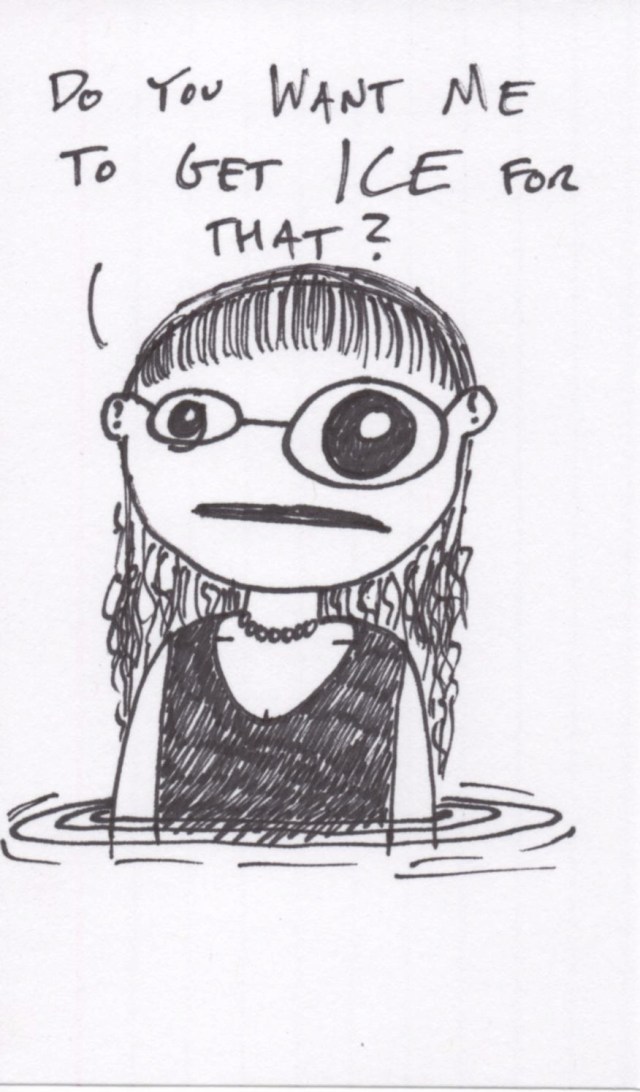
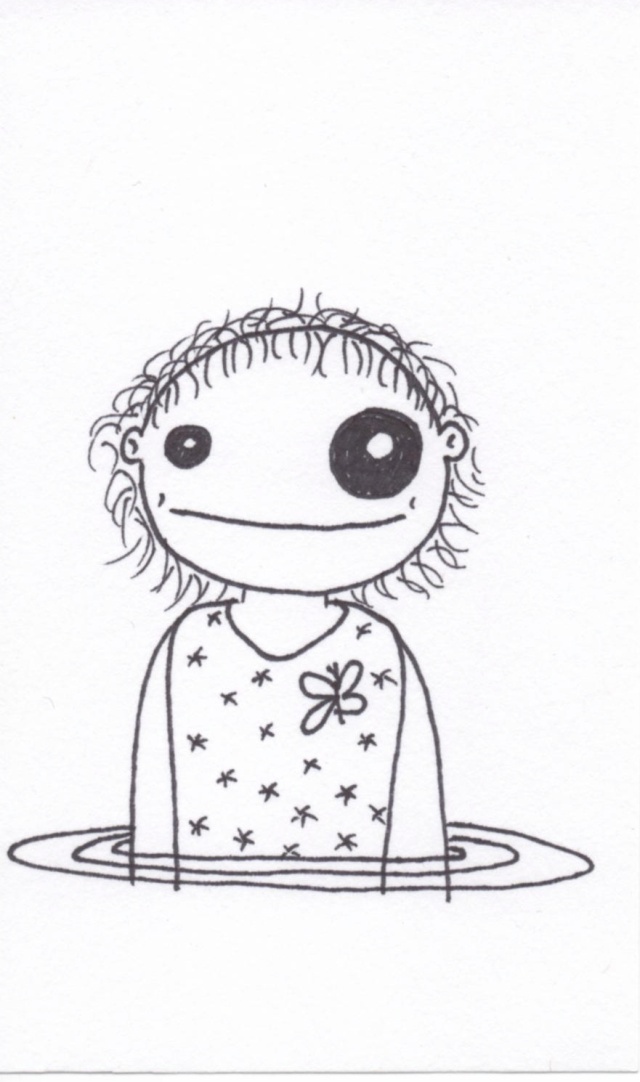
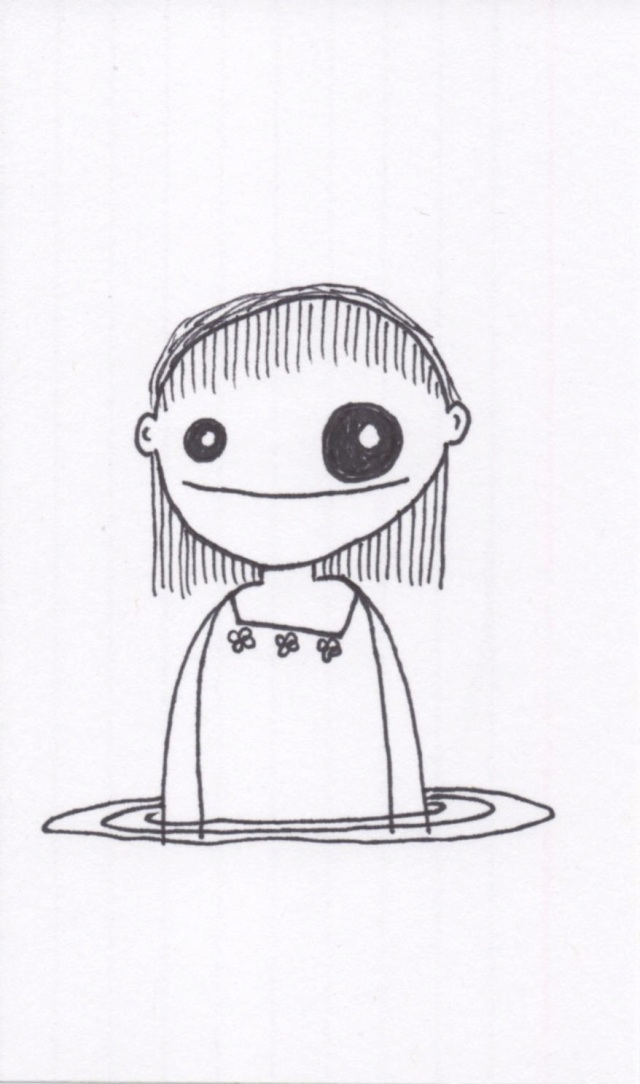
Today’s doodle, by the way, comes from my children playing with one set—the first set—of our babysitting charges. Through the course of a game, each kid laid claim to a superpower (wings, ice breath, and the like), though my second daughter couldn’t decide on just one. She periodically reinvented herself until she settled on all of them.

I wonder what turning into everything would look like. Marvel, get on this please. I’m sure it could fit in one of your X-Men titles. You’ve got, like, 50 of them.

Check back tomorrow for a new weekly theme, more doodles (yes, there’s a unique one for each post), and other Shallow stuff.

Until then (and speaking of Dark Crystal), what movie terrified you as a kid?

Reality Week: Fighting Monsters

Reality Week: Fighting Monsters

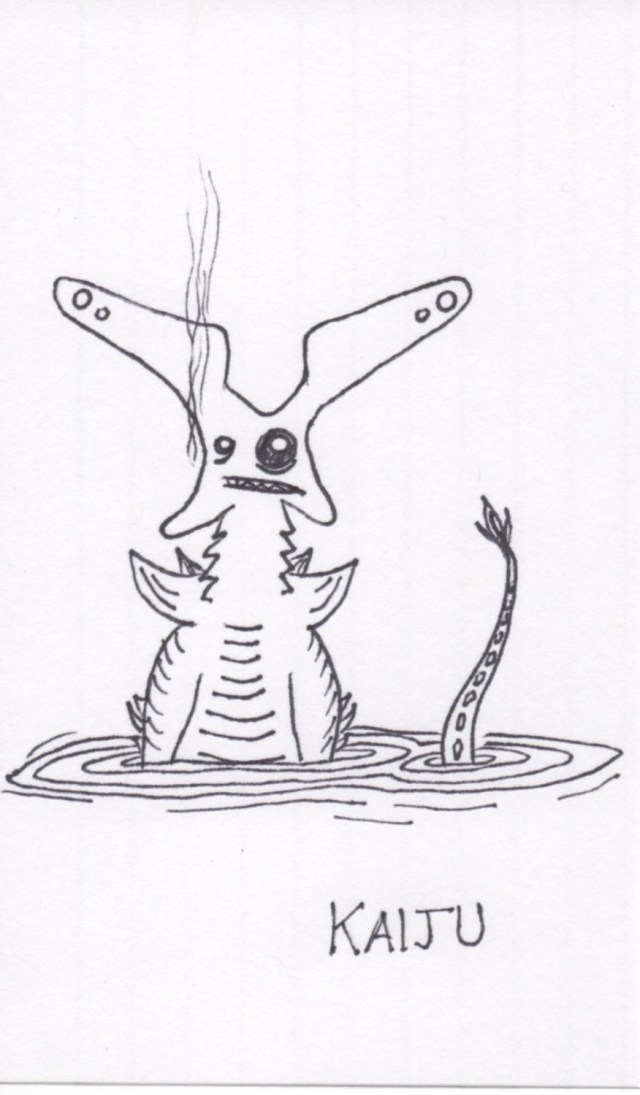
In addition to my anniversary—the highlight of my recent memory—I’d been looking forward for quite some time to watching Pacific Rim this week. I missed my chance to see it in theaters over the summer, so when I saw that it was coming out on DVD on Oct. 15, I pegged it as something with which to mark the end of a busy batch of days. It features giant mechanical warriors pummeling equally giant—like, Godzilla-sized—monsters (kaiju, to you), and there doesn’t need to be any more explanation than that.

I tend to do organize my busy life that way. I pick some upcoming event on an upcoming day and set my sights on it, thinking to myself, “Just make it to then, and you’ll be fine.” It’s a good way to not get bogged down by daily stresses and sadnesses, of which there are an Artax-sinking plenty, but the method also has some major flaws.

First, it keeps me from the present. I won’t necessarily be fully here if my mind is camping out there.

Second, it’s not a real ending. I get to my Friday (or whenever) finish line, only to find that it’s actually just a checkpoint. I know the race isn’t over, but I still act like it will be.

Third, it’s easily derailed. If I’m burning all my energy and focus with the expectation of a reprieve, and then something happens to delay or cancel it, I’m stuck with a stressed-out self who put all his eggs in one basket and then balanced that basket on the edge of a wobbly table.

Still, I have to admit it’s how I operate, for good or for ill. And despite the method’s flaws, it has its payoffs.

In addition to my regular family and work responsibilities this past week (and, yes, the amazing anniversary on Wednesday, which was a recharging checkpoint all its own), I had a long evening meeting on Thursday and a big freelance deadline on Friday. Plus I recently tasked myself with creating art and text for daily blog posts (if you hadn’t noticed), which has kept me busy.

Around Wednesday, my middle kid suggested a game-centered family night for Friday, and since my wife got me the cooperative Forbidden Island for our anniversary (despite that fact that she likes games like I like jazz: It’s fine in small doses, but not generally my thing, and the longer it is and the more thinking’s required, the more its appeal drops), we had the makings of a solid end to the week. Anticipation mounted.

When Friday finally rolled around, I met my deadline. My wife said she’d make risotto for dinner. Then she picked up the last available Blu-Ray copy of Pacific Rim at our local rental place.

That’s when I started to get antsy. I came out of a work meeting to see I had a voicemail from “Wife”—as she’s literally labeled in my phone—and my first thoughts were not so much concern about whether one of my children was injured, as is often my fear when my cell rings, but that someone was sick or majorly misbehaving and the perfect Friday I had been imagining/longing for/counting on was evaporating.

Changed plans are a staple of parenthood.

But even the fact of plans changing isn’t 100 percent guaranteed.

And that’s reality. Not everything is meltdowns and car troubles, emergencies and Band-Aids and throw-up buckets. Those things will come, yes—and I’m still waiting for another shoe to drop, even as I write this, since my middle kid complained about an upset stomach as she went to bed—but there are also nights when the children don’t bicker; the risotto is cooked perfectly; the family works together to win the game; teeth-brushing and pajama-putting-on and storytime go smoothly, the baby stays asleep; and a huge robot rocket-punches an extra-dimensional lizard right in its face.

Repeatedly.

I needed that.

Reality Week: Freaky Friday

Reality Week: Freaky Friday

My kids say a lot of stuff. Relevant, irrelevant, insightful, nonsense—it comes pouring out of their little mouths in a near-constant stream.

They sing. They make up poems. They fight. They bully. They plead for just one more show. They tell me they love me, and when I say the same to them, they say, “We know. We know. You tell us all the time!” They ask for chocolate before I’ve even finished telling them they can’t have any ice cream, and then they ask for ice cream again while I’m starting to address the chocolate issue.

And they terrify.

We used to live near a cemetery. We still do, actually, but we used to live closer, within easy walking distance of this 9-acre stretch of grass studded with headstones. We treated it a bit like a park, because—hey—it’s a 9-acre stretch of grass. Sure, there are no slides, but there’s plenty of room to run.

One day, when my firstborn was about 3 years old, we’d just finished walking around the manicured lawns and were on our way out of the gate when she stopped, turned around, waved, and shouted a cheery, “Bye!”

We were alone in the cemetery that afternoon.

“Who are you talking to?” my wife asked.

“Those kids,” my daughter said, pointing at not any kids.

Out of curiosity, I jogged over to the empty air she had apparently befriended to see what the ground beneath it had to say. The little plaques set into the dirt were all for children. I was standing on the site of either a supernatural playdate or the creepiest place ever to coincidentally conjure up some imaginary friends.

My daughter couldn’t read yet. She didn’t understand the short spans indicated by the two dates on the slabs. But she associated that section with children anyway. And she waved.

I’m reserving Fridays in the Shallows for the freaky stuff of parenting. Or at least the freaky stuff I encounter in my parenting. Many times, quotes taken out of context sound like lines from some non-dome-related Stephen King tale, but—as with today’s cartoon—I’m almost just as likely to hear something isolated that makes me laugh at first, and then lie awake at night.

I’m joking. Mostly.

My oldest daughter, in particular, seems to have a knack for peppering her personal monologues with the macabre. She’s fascinated by predators and bones, scary stories and mounting tension. I can tell that she already has a tendency toward the grisly. And the spooky. Because why was she thinking about her skin peeling off? And why would her boots matter at that point?

She’s probably just messing with me.

Are your kids inordinately interested in death and destruction? How about you?

Reality Week: Momentum

Reality Week: Momentum

We had dinner out. More dinner than we probably should have had: chorizo-stuffed, bacon-wrapped dates; spice-roasted beets with herbed goat cheese mousse, arugula, chili-walnut honeycomb, and citrus coulis; fried chili chickpeas—and those were just the appetizers.

Thanks to a generously given gift certificate, we were dining large for our nine-year anniversary (traditional gifts are pottery and willow, if you’re wondering). Sure, my presents to my wife fell a tad flat—I’m not the best, apparently, when it comes to shoe or underwear shopping for her—but there was a particularly thoughtful handmade gift in the mix (not the underwear, if you’re wondering), and the evening was, on the whole, a success.

Lulled, perhaps, by the meal and the attendant alcohol, we cavalierly ignored—ignored!—our babysitting friends’ offer to watch our children for longer than we had originally agreed. “The girls were already up late last night,” we reasoned, “and they’re so tired, they’ll just go to sleep when we get home. The baby, too. And then we can keep celebrating.”

I will reiterate: We had the opportunity to go to our kid-free home for about 45 minutes on our anniversary, and we convinced ourselves that there was a better option on the table.

The girls went relatively quickly to bed. The baby did not. He vacillated between manic laughter and weeping, pausing only to suck down water from a blue sippy cup like he’d just eaten a whole little Zen tray’s worth of sand. When he’d emptied one, I got him another: an orange one, which was unacceptable. I was to go blue or go away.

He didn’t want to be held. He didn’t want to be put down. He wanted my wife. He wanted me. He wanted more water. He wanted to pour the water on the bed. He didn’t know what he wanted.

And then, he flung his head backward. Into my lip. My readers without kids of their own may have heard that babies have soft spots on their skulls, and that’s true—for a while, anyway—but most of a 1-year-old’s head is actually quite hard.

Now here’s the thing: I didn’t get a cut. I didn’t bruise. My mouth throbbed for a minute or two, and then I was fine. But his little skull was like a period on a typewriter, hammering into the paper of my face.

It ended the sentence.

We tried to pick up steam again later, after I finally patted and hummed the little guy into unconsciousness on our bed, transferred him to a pillow, carried that pillow to his room like I was a waitress balancing a plate of stuffed piquillo peppers in a basil oil red wine reduction, and left him—finally!—in his crib. But it was too late.

Literally.

Don’t feel too bad for us, though. We had already managed some kid-free time (!) that morning when we first woke up.

Still, can you top our what-were-they-thinking moment when we picked up the children despite the offer for more time alone?

Reality Week: Nine Years Today

Reality Week: Nine Years Today

My wife and I wanted to get married on Halloween, but while planning for the ceremony and reception, we realized that we would someday be forced to choose: celebrate our anniversary or take the kids trick-or-treating?

We chose the trick-or-treating.

So we settled our wedding day on Oct. 16, 2004. It was a day of joy spent with family and friends, of making vows before God and our assembled guests, of officially proclaiming to the world—or at least the state—that we were henceforth and forevermore a unified force with which to be reckoned. (I originally wrote “to be reckoned with,” but the urge to correct my own grammar was too strong to let it stand.)

The day was amazing: a masquerade ball come to life because a lot of people who truly love us worked to make our vision a reality.

But it was also merely the first day of our marriage. What we were really looking forward to was yet to come. Is still yet to come.

We didn’t pick a wedding day because we wanted a wedding. We picked a wedding day because we wanted a marriage, and there is a difference. Of course there’s a difference.

I make a habit of telling engaged couples that the wedding is great and all, but the marriage is what they should be really excited about. Because the wedding—as special as it may be—is done in less than 24 hours. You plan for months or (I don’t recommend this) years, and it’s over in less time than it takes to watch an entire season of 30 Rock on Netflix.

Your parents, siblings, cousins, and die-hard friends are picking up scattered trash as you drive off, you get a few days of honeymoon, and then reality sets in.

You need to be in it for the long haul.

Nine years ago, my wife and I took our first step together, trusting that we would then take another step, and another, and another, for as long as these bodies will allow. Into the Shallows.

To my wife, my best friend, my lover, my sparring partner, the mother of my children, and all the titles and nicknames you have and will have: Happy anniversary. I love you.

Reality Week: Resource allocation

Reality Week: Resource allocation

There’s only so much of me to go around.

Admittedly, there’s more of me than there used to be. Somewhere in the comments on a prior post you’ll see that I took ballet instead of PE in high school, and I was the fittest then that I’ve ever been. College, too, was a good time for my body, as I walked everywhere and participated in some organized physical activity multiple times a week. I didn’t have chiseled abs, but I also didn’t have much of a gut.

Then I got a desk job and fell in love with a woman who cooks with real butter, and, well—the drawings of myself on this site are more flattering than you may think.

But the point is that I’m finite, even if I have more mass now than I used to. I can’t be in multiple places at once, and I can’t expend more energy than I’ve got. (For too long, anyway.) My day job as an editor is mentally taxing, riddled with ethical dilemmas and frequent fires that need putting out. Parenting three kids is even more taxing, as is secretly trying to figure out how, exactly, to do that parenting on the fly with my equally drained wife.

I was all set to write today’s post about sleep deprivation, but I found myself lacking the energy—not from being physically tired (though I am), but from being mentally and emotionally stripped bare, like my work and my children are gangly, co-conspiring, deadline-hammering and tantrum-throwing giraffes methodically devouring the leaves on my tree of will.

To be honest: I hate that. Admittedly, it’s not every day, but it’s a lot of them. And I hate that. I don’t want this blog to be my personal complaint desk staffed by you, but I hate that.

Yesterday afternoon, my 6-year-old daughter staged a major fit (Threat Level: Midnight) at a friend’s house, insulting her best friend and my other daughter in the process. Oh, and she deliberately broke a meticulously constructed model bridge her friend had built.

When I arrived to pick her up, I was far more embarrassed and contrite than my cranky daughter was, and I felt the will to do anything later in the evening slowly sap away as she subsequently fought me about: leaving the house under her own power, leaving the house at all, getting in the van under her own power, getting in the van at all, getting into her seat, staying in her seat, getting buckled, staying buckled, refraining from shouting at her sister, refraining from shouting at me, refraining from justifying her behavior as appropriate, refraining from telling us all that she wished she were the only person in the world so she could do whatever she wanted whenever she wanted.

The van had been in for a routine maintenance check earlier in the day, and it began wobbling and pulling a bit to the right as I drove home.

I have grand plans each morning. I wake up with the day vast and shimmering in front of me like a fresh whiteboard, and I proceed to fill it in with tasks and duties, hopes and goals. Life necessities (food) come first, followed by luxuries like showers. (I joke, but not much.) Then come the work obligations and mandatory chores (like buying groceries or getting the car smogged). Quality time with my children and wife—and friends, occasionally—goes up, though farther down the list than it should be. And then come my own writing projects, hobbies, and the like.

As the day goes on, I start erasing items on the board. Not because of lack of time, but because I start petering out. Some days I only erase a few things; some days I get all the way down to the essentials necessary to maintain consciousness.

Several years ago, I wrote a single line on a scrap of paper: “How strange and easy it is to go from living to simply existing.” I wasn’t in a good place when I wrote that, and I’ve been fighting it ever since. But the fight takes energy, too.

I’ll be honest with you again: I hate that I can’t do everything. I want to date my wife and spend time with each child individually and collectively and read my book club book and write the blog post I’d planned and chip away at the young adult novel bouncing around inside my head and call my parents and just zone in front of the TV for a while. Some of those things require discipline, yes, but some just need the sort of mental energy I don’t have in ready supply these days. The bad thing is that I tend to leave zoning on the whiteboard.

Because zoning is easy—and easy to justify—especially when my mind is still reeling from the day. And I love Andy Dwyer.

I’ve been finding, though, that the more I leave on the whiteboard throughout the day—even if I don’t feel like leaving it up there—the more often I get more stuff done. Like writing this. Here I am, a week into the Shallows, and I really didn’t feel like blogging. As I work on this, I still have some editing work to catch up on, a freelance deadline to meet, and (shh … don’t tell my wife) two anniversary presents to complete by Wednesday. And, oddly, I feel like I can handle that—despite the nuclear daughter-splosion and the shimmying van from earlier in the day.

Productivity breeds productivity, I guess. When I actually sit down to do the stuff on my whiteboard, I get a sort of momentum going. Yeah, I guess it is discipline. So this blog is probably good for me.

And here’s another thing I’ve learned: Time alone with my wife is always a good choice. She’s got a whiteboard, too. And I’m usually on it.

Do you have a whiteboard? How about a giraffe?

Reality Week: The things we say

Reality Week: The things we say

As I’ve noted elsewhere on this blog, my wife and I went into marriage with—we believe—expectations that acknowledged romance while making room (quite a bit of room, actually) for challenges. But a relationship isn’t all highs and lows, swinging between candle-lit dinners out and fights ending in tears. In fact, the bulk of it is spent in between those poles, even if the extremes make for more indelible memories.

So we get conversations about me buying new jeans at Ross, to replace the ones with a large hole that clearly shows off my underwear, which I nevertheless wore to church yesterday (true story); questions about scheduling trips to the mechanic and dentist on the same day; and triumphant announcements regarding fruit-fly-breeding-ground discoveries.

Children certainly contribute to the proliferation of these middle-of-the-road talks. My wife wouldn’t have been searching for the source of the fruit flies if we hadn’t packed a peach into a snack bag for my oldest daughter, then gone about our lives for a full week assuming it had been eaten and the snack bag put away.

(Children certainly contribute to the proliferation of fruit flies, too.)

These everyday words are necessary. I now own a pair of jeans that doesn’t display my choice of boxers (they had “love” written all over them, literally) to the congregation. Logistics have been worked out so that my wife won’t develop a cavity and the van’s airbag light will (hopefully) stop flashing at us. And we won’t have so many fruit flies around anymore.

These are the words our days are made of.

But there’s something more there, despite these words’ mundanity—or maybe even because of it. Choosing to spend each day with someone—knowing that most of those days will be filled with dishes and debates on bedtime and minor negotiations and all the rest—is an act of love itself. Which can make even the typical extraordinary.

Well, “extraordinary” may be a bit strong, but you get what I’m saying. My wife’s “I figured out where the fruit flies are coming from” is just like Westley’s “As you wish.”

What’s the word around your home?

This is my baby

This is my baby

When my wife and I announced that we were having a third child, people would look at our two daughters and then ask me, “Are you hoping for your boy?”

The question annoyed me. It presumed so much: That I was dissatisfied with the girls. That a boy would somehow be more mine than my daughters are. That there’s a proprietary angle to our children. That dads need sons.

We chose to wait until we actually saw the baby to find out whether we were having a boy or girl, and I subsequently worried my way through the pregnancy.

Over the last several years, I’d developed a sense of myself as a good dad for daughters. I attended tea parties and gladly visited imaginary hair and beauty salons, all while championing my girls’ simultaneous desires to get muddy and rowdy, their dreams of being entomologists, and their rights to pursue whatever paths they chose, regardless of sex or gender. I proudly told people that they were the sorts of girls who liked putting on princess dresses before they climbed up on rocks and jumped off. I wrestle with them. I love camping with them. I enjoy the makeovers they give me.

I also not-so-secretly worried that I wouldn’t know what to do with a boy, protesting that I’m not an athlete, not a typical “guy”—to which my wife pointed out that I was being just a tad sexist. My firstborn, after all, shows all the signs of being competitive, physical, coordinated, and eager to take up sports, and I have no worries about my future interactions with her. I was also raised under a model of unconditional support; my rec-major dad and super-active mom—both of whom have participated in team and individual sports my whole life—never failed to attend one of my ballet recitals or musical theater performances. Of course I will make every effort to try to understand whatever activities any of my children choose to pick up.

And then he arrived. I was convinced we were having another girl. But here was this additional XY in the house, and I found myself quickly admitting that, yes, I’m glad I now have a son. Part of me feels guilty in such an admission—but my wife, correct as usual, points out that I can be happy with daughters and a son. For different reasons. And I am.

So I’m working on not being ashamed to say that I’m thrilled to have this little guy in my life, one who already likes to watch me shave. I’ll teach him how to do the same, someday—and he’ll need to do it often. I’ll teach him how to tie a tie, if that’s his style. I’ll teach him about healthy relationships, and respecting women, and masculinity that has a positive impact on society. I hope. I’ll try.

I call him Mr. Dude or Mr. Boy, and I have only recently admitted that I am glad that there’s another person in this family who will—I think, anyway—someday see the world from a similar perspective to mine.

I don’t know any of that for sure, but I do know that he is my boy—as much as my daughters are my girls. And that’s OK.

What do you think?

This is my second daughter

This is my second daughter

I caught this one. I literally caught her as she was being born.

My wife and I chose to have home births, and everything went (relatively) smoothly with the first and third kids. There were some complications with No. 2, however, so we went to the hospital so my wife could be induced.

Once there, one thing led to another, my wife ended up on all fours in the hospital bathroom, the OB couldn’t quite get to her in time (I’m really rushing through this story), and I was the nearest person to the action. When I, well, looked underneath to see how things were going, I saw the top of a baby. I stuck out my hand, and this little girl dropped headfirst into my palm.

I promptly scooped her up to my chest, accidentally snapping her umbilical cord and sending blood fountaining everywhere. The OB had made it into the room by then and calmly clamped what needed clamping, checked what needed checking, and calmed down what needed calming down.

She’s had a relatively less chaotic life since then (my daughter, I mean; I have no idea how the OB has fared). As the second kid, she looks up to her big sister, for good and for ill. She’s the cuddliest of the three, and (don’t tell her siblings I said this), she has the best comedic timing.

Her: I’m hungry.
Me: …
Her: Actually, I’m thirsty.
Me: …
Her: Actually, I have to go potty.

She’s as stubborn as her older sister, but in a different way, which feels unfair to me. Until I had two kids, I didn’t know there were different kinds of stubbornness.

The biggest lesson she’s taught me is that a second child isn’t a repeat of the first child, which—sure—sounds obvious, but I’m amazed at how long it took me to figure it out. I love her distinct personality, her subtle zaniness, and her hugs. She’s a peacemaker, which I admire, but that quality also makes me worry, because I want so desperately for her to stand up for herself and make her own voice heard in a world/society/school/family full of voices trying to talk louder than she can—or will.

I’m apparently worse at drawing dimples than I am at hands, but I can’t draw ripples on the sides of her face, thus those little dents in my illustration.

Finally, some questions (and I ask for no reason, no reason at all): Fellow second children, did your parents take fewer pictures and videos of you than they did of your older sibling? And how messed up are you because of that?

This is my firstborn

This is my firstborn

In Ben Folds’ “Still Fighting It,” he sings, to his young child, “You’re so much like me. I’m sorry.”

I love the song, and I love that line, though my enjoyment of the words was pretty much abstract until my first daughter came into my life and showed me what I would have been like if I had been born a blond girl.

Some of it is positive, I think. She genuinely laughs at what I laugh at. She’s into bugs and sharks and owl pellets. Her favorite part of “The Empire Strikes Back” is at the end, when Luke gets his new robotic hand, and she can perfectly imitate the twitches he makes as the droid jabs his fingers to make sure the synthetic nerves are working. She tells stories and gets lost in the telling.

She also gets frustrated like I got (and get) frustrated. She gets inordinately angry when she doesn’t immediately grasp and master a new skill. Being right is incredibly important to her in every discussion/debate/argument. Vitally important. As important and inevitable as gravity.

Throughout my childhood, my parents often told me that they hoped I’d someday have a kid just like me. It was a blessing, I think, and a curse. While my firstborn daughter—my firstborn child—looks like my wife, she acts like me and seems to think like me. I can’t tell if it’s nature or nurture. Sometimes (as when she suddenly exclaimed, on the way to kindergarten, “Dad, the future turns into the past!”) I am thrilled to hear my voice echoing somehow in hers. She’s fascinated by science. She falls asleep reading, with her book still propped upright in her hands—an ability I’ve only seen demonstrated elsewhere in myself (actually, I’ve been told of it, since I’m unconscious when it happens).

But she is so, so stubborn. When my wife and I are feeling charitable, we call her “willful” or “persistent” or “committed.” But most of the time we just say she’s stubborn—though we do take comfort in knowing that the challenging qualities of today will someday benefit her when she’s a supreme court justice.

An anecdote to end this on:

I once gave her a dollar I had in my pocket when I got home from work.

Her: Oh, thank you! You’re my best daddy!
Me: Oh yeah? Who’s your not-best daddy?
Her: You, sometimes.